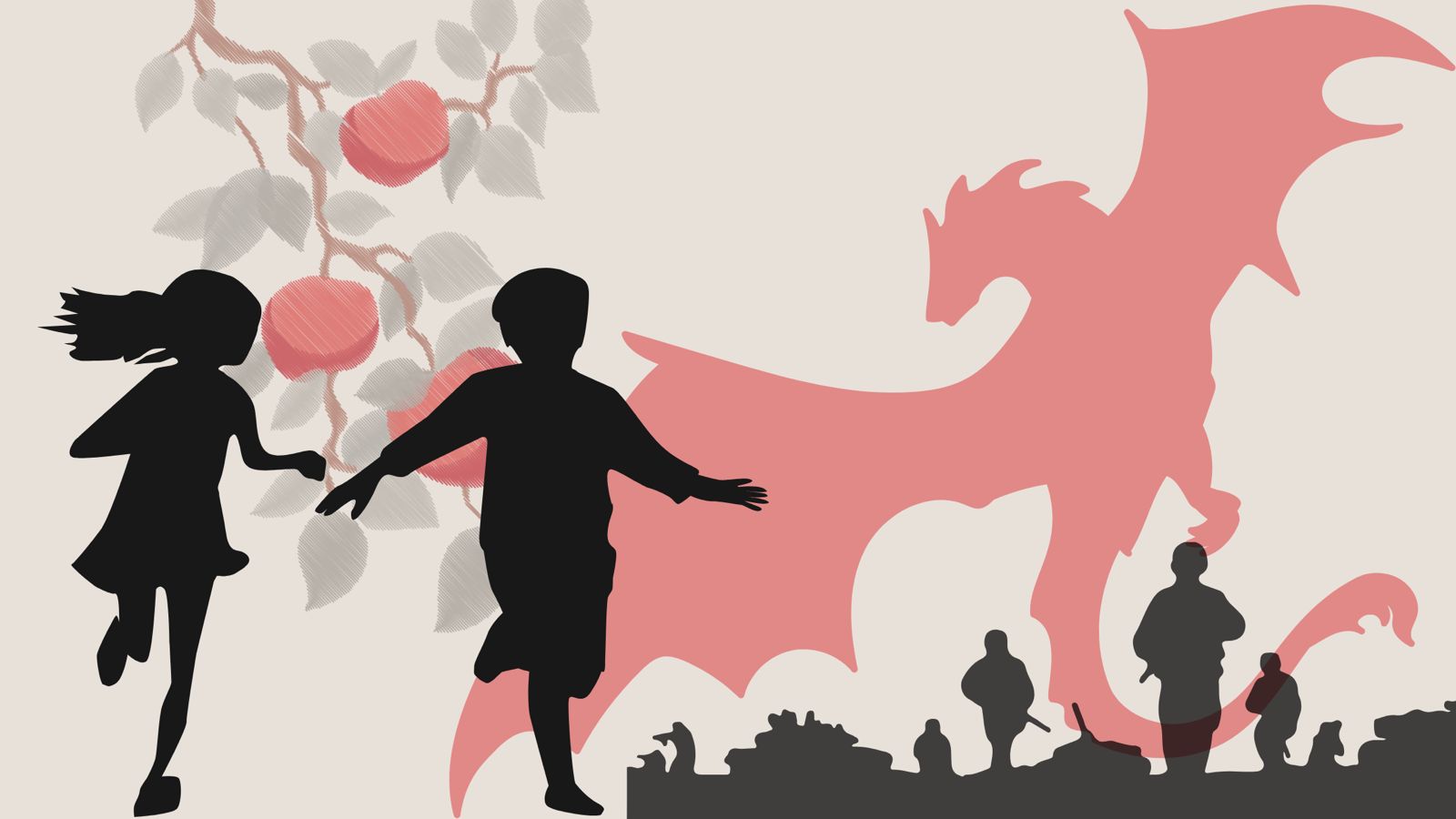
We all remember the last harvest before the Dragon descended upon our land. Before he flapped his wings victoriously from the town hall, where our nation’s flag had once flown. Before his roar sounded from the engines of the foreign tanks rolling down our streets. Before his fuming breath coughed dust and gravel under the boots of the soldiers who had defeated our fathers.
It was the end of the Before times, but since we didn’t know it yet, it was only the end of summer. To Lena and Zlatan, like many of us, it was also the day before their fathers marched off to the front, but even this came second to the apple harvest. The two of them sat in the shade of the old garden and watched produce carts creep up the serpentine road, workers and mules groaning under the weight of the last Lategolds in the sweltering afternoon sun. Lena and Zlatan could see the whole valley from there, and, in that moment, they couldn’t imagine anything other than the harvest could ever move, shake, or turn this patch of land that made up their whole world.
“Did you know the golden apple tree, the one from the story, stood right here in this garden?” Lena said. “My Babka told me so.”
Lena’s grandmother had lived her whole life in the old house, and, under her husband’s laborious efforts and her son’s enterprising prowess, had seen its land grow from a fallow field into the largest orchard in the valley.
Zlatan, who was a year older than Lena and had a reputation to maintain, didn’t seem convinced. “Your Babka’s wits are as sharp as puree. Just yesterday, she forgot again who I was. Tried to chase me off with a rolling pin. Get outta here, you dirty thief!” He imitated her, waving around a stick.
Zlatan’s family worked for Lena’s father as “fruit tramps.” Each spring, they traveled down the valley,following the harvest north to south, orchard to orchard.Come fall, they headed back, playing their music at town fairs and weddings, and selling their hands’ labor to whoever would buy it. For Lena, the harvest’s end was a time of bittersweet emotion; the joy of going back to school was always tainted by the sadness of seeing Zlatan go.
This year was different. War had come to the north, and instead of the colorful caravan train, the harvest parade would be seeing our town’s men off to fight.
“Imagine though, if we still had the tree,” Lena insisted. “The Dragon would come to steal the golden apple.” For all his pretense of mature skepticism, the idea excited Zlatan. His stick transformed from a rolling pin into a knight’s sword. “If you slayed the Dragon, then maybe Tata would let us marry when we’re older,” Lena added.
Zlatan stopped wielding the stick, and gave her a mournful look. “Fairy tales have filled your head with hay. Our fathers will never allow us to marry. I’m a gypsy, and you’re gadjé. It’s pesh.”
Zlatan had developed a preference for his own Babka’s Romani tales and their bittersweet endings. “I will dance at your wedding, though. Like the fiddler from our story.”
That evening, Lena’s father sat her on his lap and read fairy tales to her one last time. She wanted to hear the one about the fiddler, but it wasn’t in the book. Romani tales rarely were, but if there was one place they should be, Lena thought, it was in The Golden Apple and Other Tales from the Golden Valley. After all, the valley wouldn’t be called that if it wasn’t for the fruit tramps blessing every apple orchard on their caravan path with the golden touch of their calloused hands.
Lena was contemplating asking her father about it when her Babka waddled into the living room, carrying a small box lined with velvet the color of pines—like her father’s uniform.
“Your Diadek wore these in the first war,” she said to Lena as she attached the gold cufflinks to her father’s army coat sleeves. “They are enchanted with the magic of our ancestors. They will keep your Tata safe.”
This gave Lena an idea.
The next morning, we watched our men parade up the town road, marching and singing while the rest of us cheered atop market carts. Zlatan and his cousins had taken on the role of fruit boys: running up and down the stream of shiny uniforms, handing out fruit and homebrew flasks to the soldiers for courage.
“Zlatan!” Lena called out from the crowd. She ran up to him and took his hand. Zlatan felt a small metal object in between their clutched palms. “I went to the Old Witch last night. I nursed her reptiles and she gave me a magic amulet.” Zlatan opened his palm. Lena had given him a gold lizard-shaped brooch. “It’s for your father. To keep him safe.”
Lena and Zlatan had looked for the Old Witch in the woods many a time before, and at one point each had claimed to have found her chicken-legged house without the other. Zlatan was too old to believe such nonsense anymore, and had even seen Lena’s mother wear the brooch before. But Zlatan was also old enough to understand the meaning of gifted gold.
Everything changed soon after, but it was all which remained the same that haunted us. Our men didn’t return from the front—killed or captured, nobody knew—but new men came and took their places. They were strange men, foreigners. The enemy. They walked our streets, frequented our pubs, and slept in our houses. We told ourselves we had no choice but to let them. It was easy enough to believe: those who protested were taken, beaten, never heard of again. We had become the Dragon’s maidens—prisoners in his dungeon, tending to his whims until a brave knight came to our rescue. But all the brave men were gone, and we were alone with the monster that had made his lair in our bedchambers.
When the Dragon came to Lena’s doorstep, she began to learn about the price of gold.
Her mother rushed into the kitchen, covered up to her knees in mud. She had run straight from town, cutting across the field to get there before they did.
“Quick, Lenuchka,” she put her arms on Lena’s shoulders, “I need you to go upstairs and find my jewelry box. Take everything and hide it in the cellar. You know how to get in from the barn?”
Lena nodded. More than once she had beaten Zlatan at hide-and-seek thanks to the secret trap door.
As two billeted officers settled into the old house and made it their own, driving Lena and her mother out of the upstairs bedrooms, and confining Babka to round-the-clock kitchen duty, Lena understood the difference between the Old Witch and the Dragon. The Witch was scary-looking and tempestuous, but she was fair. She only punished the lazy and careless who came into her house looking for treasures, but didn’t bother with her reptiles. Those who left their prejudice at the door and treated her beasts with kindness were showered with gifts of gold.
There was no such reasoning with the Dragon. He had taken their village, melted all the gold he could find into more weapons for his conquests, and they only had one choice: learn to live with him, or face his wrath. Lena’s mother had been smart. When meat and cheese became luxuries reserved for the soldiers, even the scraps jealously guarded behind endless lines and ration coupons, it was her mother’s golden earrings that kept fresh food on the table. When winter came, and the last of the chopped firewood turned to ash in the upstairs bedrooms, it was Babka’s pearls that kept the rest of the house from freezing.
Lena’s mother was not the only one that winter to turn gold into pork and timber, but not all of us were afforded the use of this practical magic. The caravan camp at the edge of town where Zlatan had stayed with his mother and aunts was raided and stripped of all valuables before they could even think to hide them. Gypsies were known for their scheming and sorcery, the major who had taken over her parents’ bedroom told Lena one night as he sipped on her father’s homebrew. Their gold beads and evil eyes could cast blood curses on the advancing armies. Their savagery was poison to the new order, and needed to be weeded out to keep the rot away from fertile ground.
Lena didn’t understand how the people who tended her family’s bountiful orchard, and whose music brought joy to her town’s harvest parade each year, could be blamed for poisoning the land by the men who had stolen it. But many among us understood, or pretended to. When segregation orders hung from baths, pubs, and classroom doors, we averted our gazes. When those were replaced with entry bans, we kept staring down at our shoes that would get us through winter, fiddling with the coins in our pockets we would be allowed to spend.
“Stop! Why are you doing this?” Lena shouted at the soldier who led Zlatan and the other caravan kids out of the school building. The rest of us understood and watched from afar.
“It’s alright, Lena, go back inside.” Zlatan winked at her. “Never was much for schooling anyway.”
Lena cried herself to sleep that night. The idea of seeking out the Old Witch didn’t even cross her mind this time—she no longer believed in fairy tales.
Yet, it was her mother who did precisely that the next morning.
“You can’t tell anyone about this, Lenuchka, not even Babka,” she said as they walked up the narrow forest trail behind their house. They could see in the distance the road on which the officers had driven off to a campaign at dawn.
The Witch was younger than Lena had imagined, although her tangled hair and rugged clothes suggested she had roamed the woods for a while. She knelt beside Lena and said, “Doing good in our current world is like casting a spell: it must remain invisible, except to those who believe in it. Do you understand, child?”
Lena wasn’t sure she did, but she nodded.
Each next time they met the not-so-old Witch, she gave them a new errand. Sometimes, it was a stack of spells—pamphlets, Lena’s mother called them—they had to secretly deliver to people in town who still believed in magic. Other times, someone needed to disappear, and they smuggled the enchanted ingredients—papers, seals, disguises—that would turn them into someone else.
Thanks to their hidden gold, Lena’s family was among the few who could still afford fresh meat. Their daily trips to the market provided cover for the secret missions, and sometimes, a chance for Lena to see Zlatan again. Sneaking behind market carts, she brought him food baskets, and told him stories of the Witch’s assignments. Zlatan was too old for fairy tales, but each night, he stood by the campfire and retold the stories to his people, adding a flask of hope to Lena’s offerings.
Summer was on its last legs, but there was no harvest to celebrate. The fruit tramps were barred from working, and what little produce our fields reluctantly yielded without the loving hands of their faithful laborers was to feed the troops in their insatiable conquests. In the absence of festivities, the Dragon prepared to flood our streets with his own victory parade.
And in the shame of our subjugation, some of us had forgotten who the enemy was, falsely recognizing its fire-spitting grimace in the faces of our former friends.
This was how Zlatan’s people ended up at Lena’s doorstep on that fateful night. Some claim it was the Dragon, but we all know it was our own torches that set fire to their camp. We all know it was only the officers’ preoccupation with the upcoming fanfare that allowed Lena and her mother to hide everyone in the cellar. The cellar that Lena’s father had only built and stocked with homebrew because the gypsies had blessed his land with more fruit than he could sell.
“It’s not fair!” Lena sobbed as she and Zlatan led the women and children up the dark forest path, her mother keeping watch at the tail. “The Witch was supposed to help us defeat the Dragon, not just smuggle you to the Free Zone.” She didn’t know where the Free Zone was, but it was where Zlatan was headed, and she wasn’t.
Zlatan squeezed her hand. “I told you gypsy tales have bittersweet endings.” He didn’t notice Lena slip the last of her family jewels, her Babka’s wedding band, into his pocket.
Lena’s family moved after the war, and nobody could agree how her and Zlatan’s story ended. Some say they found each other and married in the Free Zone, under the branches of a golden apple tree. Others claim Zlatan sold her Babka’s ring for a fiddle, became a famous musician, and played at Lena’s wedding. We all tell and retell these stories, the happy and the bittersweet. We do it because there will always be those who tell other stories—ones of thieving tramps and evil eyes—and we had all believed them once, clutching our gold and sharpening our pitchforks.